
When a French VAT-registered business sells goods to a VAT-registered business in another EU country, the sale is exempt from French VAT if the customer gives a valid intra-EU VAT number, the goods physically leave France for another member state and the seller files a recapitulative statement (état récapitulatif) with customs. The invoice is issued without VAT, shows both VAT numbers and carries the mention "Exonération TVA, article 262 ter - I du CGI". For business-to-business services, the general rule is that VAT is due in the customer's country, and the customer accounts for it under the reverse charge (autoliquidation); the invoice shows the customer's VAT number and the word "autoliquidation", and the seller files a European services declaration (déclaration européenne de services, DES). Both statements are monthly, due at the latest on the 10th working day of the following month. This guide explains each rule, with examples from a Burgundy wine exporter and a Paris software studio.
Goods: the four conditions for exemption
A sale of goods from France to another EU country (livraison intracommunautaire) is exempt from VAT only if all of these conditions are met:
- The seller is a taxable person acting as such, and the sale is for consideration.
- The buyer is a taxable person (or a non-taxable legal entity) that is not under a special scheme such as a small business exemption in its own country.
- The buyer gives a valid intra-EU VAT number issued by a member state other than France. The seller should check it on the European Commission's VIES service.
- The goods leave France for another member state, and the seller can prove it with two independent, non-contradictory pieces of evidence, for example a signed transport document and the carrier's invoice.
On top of these, the seller must file the recapitulative statement for the sale. If a condition fails, the sale is taxed in France as a domestic sale. And if VAT is shown on an invoice for an exempt sale, even by mistake, the seller owes that VAT.
The invoice for an exempt EU supply of goods
The invoice is issued excluding VAT. In addition to the usual mandatory details on a French invoice, it shows the seller's and the buyer's intra-EU VAT numbers and the mention "Exonération TVA, article 262 ter - I du CGI".
Worked example: a Burgundy wine exporter
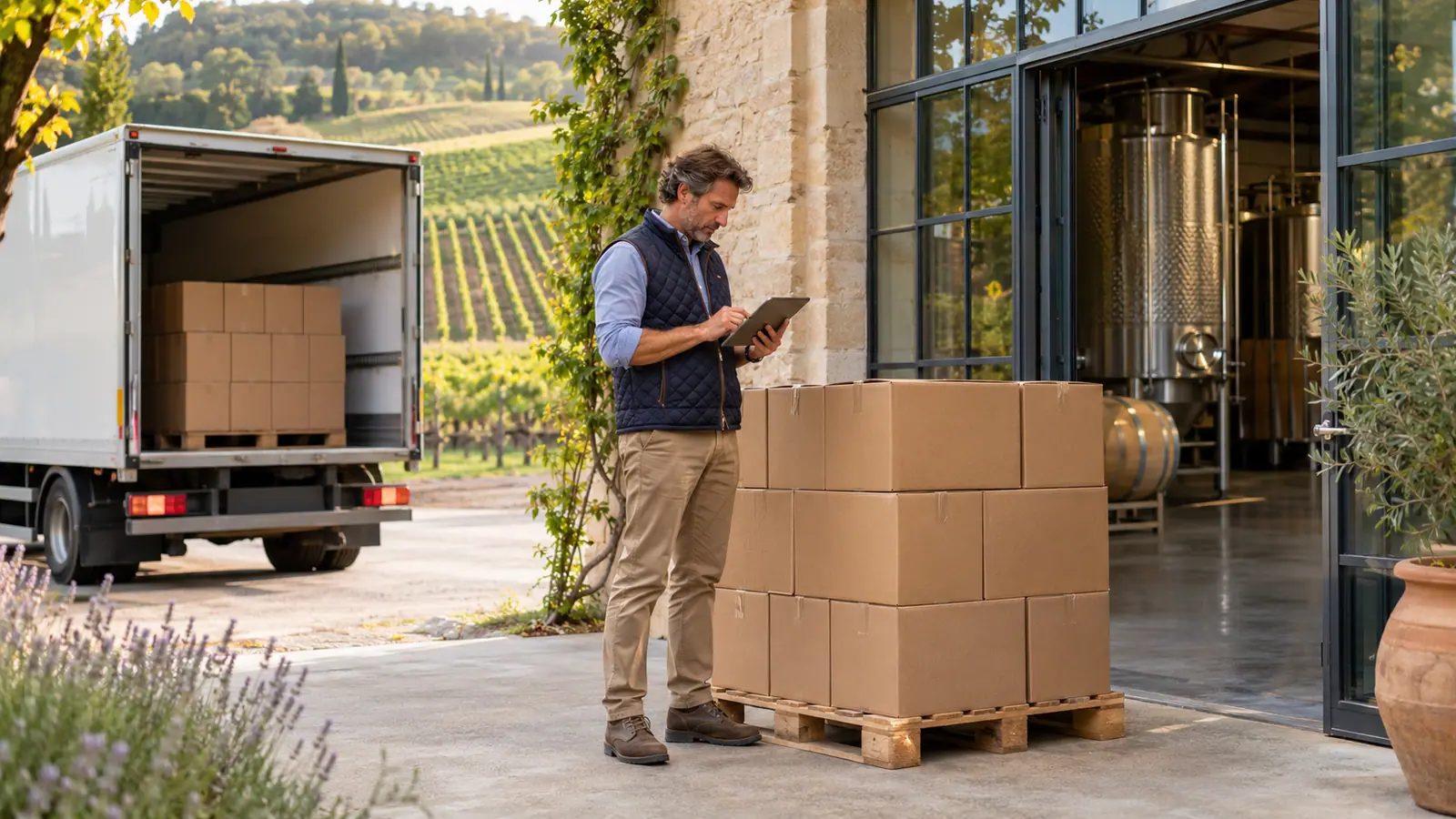
Domaine des Côtes Fines SARL, a fictional wine estate near Beaune, sells 600 cases to a Belgian wine merchant, a VAT-registered company in Ghent, for EUR 54,000. Before accepting the order, the estate's office checks the Belgian VAT number on VIES and saves the result. The goods are collected by a carrier and delivered to Ghent; the estate keeps the signed transport document and the carrier's invoice as its two proofs. The invoice shows EUR 54,000 with no VAT, both VAT numbers and the article 262 ter mention. In the following month the estate files its recapitulative statement listing the Belgian customer's VAT number and the EUR 54,000, and reports the exempt supply on its VAT return. Wine is an excise product, so the estate also has excise formalities to deal with, which are outside the scope of this article.
Services: the general B2B rule and reverse charge
For most services between businesses, VAT is due in the country where the customer is established. A French provider selling to an EU business customer therefore does not charge French VAT; the customer accounts for VAT in its own country under the reverse charge. The French provider's invoice:
- is issued without French VAT;
- shows the customer's intra-EU VAT number alongside the provider's own;
- carries the mention "autoliquidation".
There are exceptions to the general rule where VAT is due elsewhere, for example services connected with immovable property, passenger transport, admission to events, restaurant services, short-term hire of means of transport and some travel agency services. Check the specific rule before invoicing those.
A Paris software studio, Studio Pixelvert SAS, invoices a Dutch retailer EUR 18,000 for building a custom ordering tool. The retailer is VAT-registered in the Netherlands. The invoice shows EUR 18,000 without French VAT, both VAT numbers and "autoliquidation". The studio files a DES for the month in which VAT became chargeable in the Netherlands.
Buying from the EU: reverse charge on your side
The mirror image applies when you buy. If an EU supplier without a French VAT number sells goods to your French business, it invoices without VAT and the invoice carries "autoliquidation". You declare the VAT on your return as VAT due and, if you are entitled to deduct it, deduct the same amount, so the net cost is usually zero. The same applies to services bought from EU suppliers: you self-assess French VAT and deduct it where you can. On the CA3 return, intra-EU acquisitions of goods and purchases of services from non-established suppliers go on specific lines, so book them with their own VAT codes. See French VAT rates and returns for how the return is built.
Businesses under the small business VAT exemption have their own threshold for EU purchases: see the French VAT exemption scheme.
The monthly statements: état récapitulatif and DES
| Statement | Who files | Frequency and deadline | Where |
|---|---|---|---|
| État récapitulatif TVA (goods) | French seller of exempt EU supplies of goods | Monthly, at the latest the 10th working day of the following month | DEBWEB2 service on douane.gouv.fr |
| DES (services) | French provider of B2B services taxed in the customer's EU country | Monthly, at the latest the 10th working day of the following month | DES service on douane.gouv.fr |
| EMEBI (statistical survey) | Businesses that receive a notice from customs | As stated in the notice, completed before the état récapitulatif | DEBWEB2 |
The DES applies only to the seller: a French business that buys services from EU suppliers does not file one. The working-day count excludes the weekly rest day and holidays not normally worked in the business. You need a personal account on the douane.gouv.fr portal for both services.
VIES checks: do them every time
A VAT number that was valid last year may not be valid today. Official guidance recommends checking your partner's number before each transaction on VIES. Two practical points:
- VIES cannot look up a number from a company name. You need the number from the customer.
- If the number is invalid, ask the customer for a certificate of taxable status (attestation d'assujettissement) from its own tax authority. Without one, invoice under French VAT rules.
Save the dated VIES result with the customer record and the invoice. It is the first thing an inspector asks for when an exempt supply is questioned.
Common mistakes
- Accepting a VAT number by email without checking it.
- No proof the goods left France, especially when the customer collects with its own vehicle. Agree in advance which documents the customer will return.
- Mismatches between the VAT return and the statements. The exempt supplies on your return should agree with the état récapitulatif for the same period.
- Charging VAT by mistake on an exempt sale: you owe it, and the customer may not be able to deduct it.
- Forgetting the DES for services, which small studios and consultancies often overlook.
A monthly routine for EU sales
- At customer creation: record the VAT number, check it on VIES and save the dated result.
- At each order: re-check the number on VIES if the order is large or the last check is old.
- At delivery: collect the two proofs of transport and attach them to the delivery record.
- At invoicing: apply the exempt or reverse charge VAT code so the right wording prints automatically.
- Before the 10th working day: extract EU sales of goods and services for the month and file the état récapitulatif and the DES.
- Before the VAT return: agree the exempt EU supplies on the return with the statements just filed.
Keeping the data in one place
Each EU sale touches customer data (VAT number and VIES evidence), logistics (proof of transport), invoicing (wording and VAT code) and reporting (return and statements). When those live in separate tools, reconciliation becomes a monthly chore. An ERP such as Fininvo keeps customer records, deliveries, invoices and accounts in one system, so the same sale feeds the ledger and the figures you prepare for your statements.
Rules checked in November 2026 against DGFiP, French customs, Service Public Entreprendre and European Commission guidance. This article is general information, not tax or legal advice; confirm current rates and thresholds with the DGFiP or a qualified adviser.
FAQ
What wording goes on an invoice for an exempt EU sale of goods?
"Exonération TVA, article 262 ter - I du CGI", plus the seller's and buyer's intra-EU VAT numbers.
What wording goes on an invoice for B2B services to an EU customer?
The word "autoliquidation", with the customer's intra-EU VAT number, and no French VAT.
When are the état récapitulatif and the DES due?
Monthly, at the latest on the 10th working day of the month after the reference month.
What happens if my customer's VAT number is not valid?
Ask for an attestation d'assujettissement from its tax authority. Without it, invoice the sale with French VAT.
Do I file a DES when I buy services from an EU supplier?
No. Only the seller files the DES. As a buyer you self-assess VAT on your return.
How do I prove goods left France?
Keep two independent pieces of evidence, such as a signed transport document and the carrier's invoice, or proof of payment for the transport.
Topics
Share this article
Get new articles by email
Practical guides on VAT, bookkeeping and running a business in France. Unsubscribe anytime.
Related articles



Fininvo ERP
Run accounts, VAT and inventory in one place
Invoices, purchases, stock and tax reports stay in sync. Start your 14-day free trial.